
What Is a Fractional Recruiter? (And When a Startup Actually Needs One)
This article was written by Brandon Ram, a recruiting leader with nearly 20 years of experience building teams for high-growth tech companies, and founder of InTandem Talent.
It's a familiar struggle for startups and growth-stage companies. Your company just closed a major raise, you've been given an ambitious growth plan, and the roles start to pile up faster than anyone can fill them.
Then things get ugly.
Interviews slip, strong candidates go cold, and the roadmap waits on hires that haven't happened yet. You know you need help, but you can't bet permanent headcount on a hiring surge that might quiet down in six months. And you've seen enough recruitment agencies to be wary of them too.
That's usually when founders and People leaders start weighing three options: a recruiting agency, a fractional recruiter, or growing recruitment in house.
This article covers what a fractional recruiter is, how it compares to an agency and to growing recruitment in house, and when each one makes sense.
What is a fractional recruiter?
A fractional recruiter is a senior recruiting partner who supports you on a flat monthly retainer instead of a commission on each placement. You get the judgment of a talent leader and the execution skills of a seasoned team, without adding full-time salary.
In practice, a good fractional recruiter supports you wherever you need it across the hiring lifecycle. That might be talent strategy and building the process (intake, scorecards, the right ATS, candidate experience), hands-on recruiting from role definition through offer, or all of it in one partner. Whatever the mix, the work happens embedded in your team, so candidates experience your recruiter as part of your company.
Typically, the engagement scales up or down as your hiring plan changes.
Why startups and growth-stage companies are better served by fractional
An agency can work fine for an established company with an HR team, a mature hiring process, and the occasional backfill. Early-stage and growth-stage companies are a different animal, for a few reasons.
The incentives are aligned to your needs. A fractional recruiter earns the same flat retainer whether your role closes in a week or a month, so there's no reason to rush a candidate through or skip the hard conversation about whether the role is defined right.
Every hire is outsized. At 30 or 40 people, one wrong VP of Sales put the entire business trajectory at risk. Between the search, the ramp up, the exit, and the restart, a bad hire can put you six months to a year behind.
There's no process for an agency to plug into. Agencies assume you'll run intake, interview loops and candidate experience. Most startups don't have any of that yet, and a fractional recruiter builds it as part of the work.
Hiring comes in waves. After a raise you might need five people in a quarter, then nothing for months. Fractional is designed to flex with that.
Founder time is the scarcest resource you have. Every hour spent chasing candidates and scheduling interviews is an hour not spent on product, customers or the next round. An agency hands you resumes. A fractional recruiter hands you back your calendar.
Comparing fractional recruiter vs. contingency agency vs. in-house recruiter
Neither model is objectively good or bad. They just reward different things. Here's the side-by-side, including the in-house option most founders are also weighing.
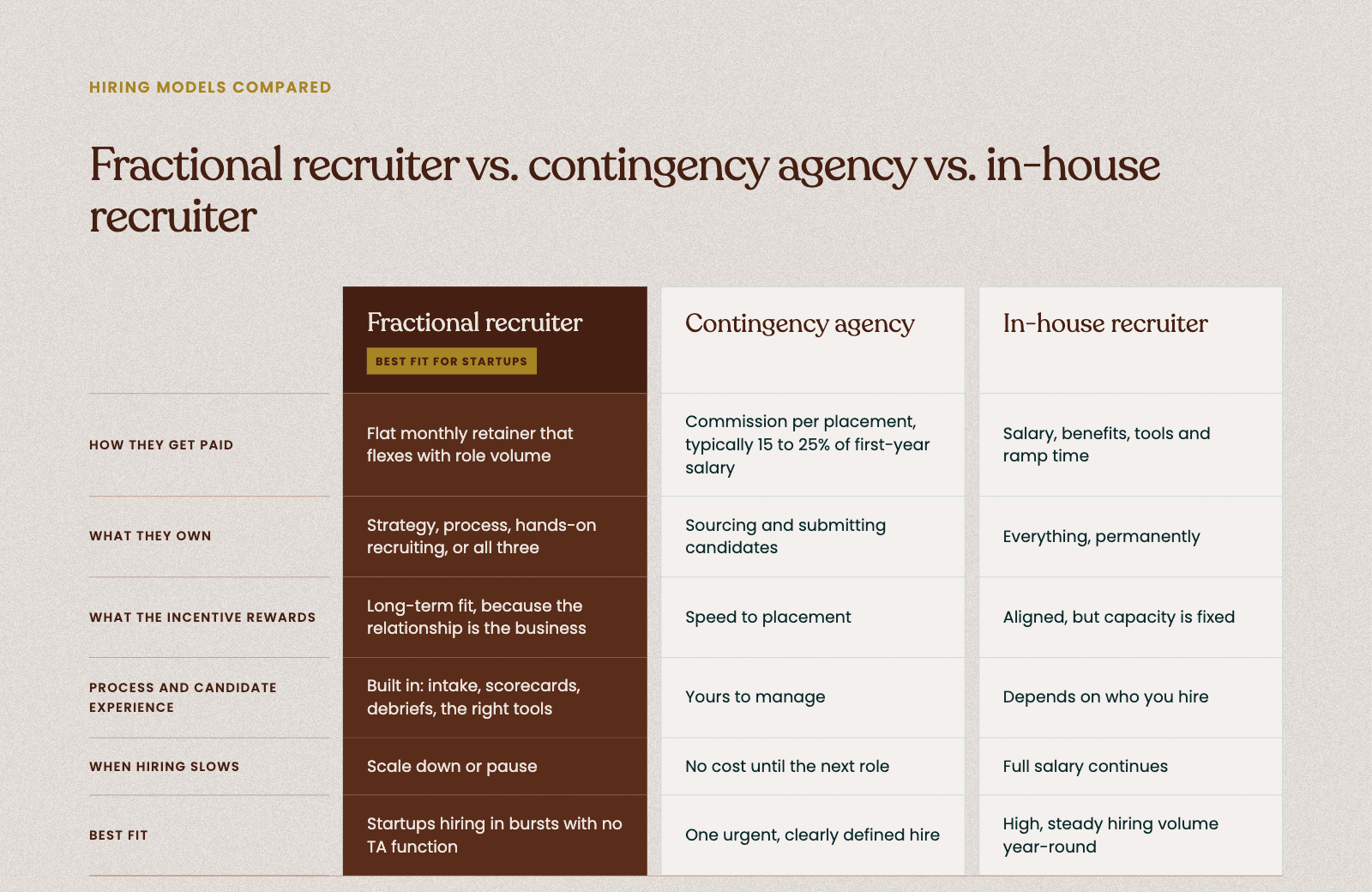
Here's how each model compares on the things that matter most when you're hiring at growth stage.
Compensation
Fractional recruiter: a flat monthly retainer. Predictable spend that flexes up or down with how many roles you're hiring for.
Recruitment agency: a commission on every hire. Typically 15 to 25% of first-year salary. Nothing upfront, but three or four placements in a quarter can reach six figures.
In-house recruiter: a fixed salary. Plus benefits, tools and ramp time, whether you have ten open roles or none.
Incentives
Fractional recruiter: rewarded for hires that last. The relationship is the business, so there's no reason to rush a candidate through.
Recruitment agency: rewarded for placements. The commission pays on an accepted offer, which quietly pushes toward speed and volume.
In-house recruiter: fully aligned, limited capacity. They want what you want, but there's only one of them.
Scope of support
Fractional recruiter: as much or as little as you need. Talent strategy, process, hands-on recruiting, or all of it in one partner.
Recruitment agency: sourcing and submitting candidates. You still need to run intake, interviews, offers, onboarding and candidate experience.
In-house recruiter: everything, permanently. One person rarely brings both senior strategy and day-to-day capacity at your stage.
Process and candidate experience
Fractional recruiter: built in. Intake meetings, scorecards, debriefs and the right tools come with the engagement.
Recruitment agency: yours to manage. Many companies also run their own posting and screening in parallel, doubling the work.
In-house recruiter: depends on the hire. Strong process takes time to build, and time is what a solo recruiter has least of.
Flexibility when hiring changes
Fractional recruiter: scales with you. Ramp up after a raise, scale down or pause in a quiet quarter.
Recruitment agency: easy to start and stop. But you pay the full commission every single time.
In-house recruiter: hard to flex. A recruiter hired for a surge becomes a cost in the lull, and TA teams are usually the first cut in a layoff.
Commitment and risk
Fractional recruiter: a monthly commitment. You pay in slow months too, so it earns its keep with a steady flow of roles and an engaged hiring team.
Recruitment agency: low commitment. Easy to try for one search, and good agencies bring deep niche networks.
In-house recruiter: a long-term bet. It pays off once hiring volume is high and steady year-round.
Why we built InTandem as a fractional recruiting partner
Our team has spent nearly two decades in recruiting, and we've seen what happens when the incentive structure isn't aligned to our client's best interests. Roles get filled before anyone agrees on what the role is. Good candidates get rushed (out the door). Leaders end up managing the fallout of bad hires that looked right on paper. None of that comes from nefarious intentions. It comes from a model that pays for the placement and not the outcome.
So when we started InTandem, we built it differently. One flat monthly retainer. One partner who takes on as much of your hiring as you need, inside your team. No reason to tell you anything but the truth about a candidate, a role, or your comp.
Here's what that looks like in practice, across our clients:
Most clients start seeing relevant candidates within one to two weeks.
Our longest-running client started with a single search two years ago and still works with us across multiple roles.
For one scale-up, we cut their hiring process from roughly 20 steps to 10 and moved them onto an ATS built for their size.
We've recruited ourselves out of money, filling roles so fast that the engagement wrapped early. Which is fine. That's the model working.
That last one is the clearest proof the incentives are right. Under a commission model, finishing early is a windfall. Under ours, it means we did our job well enough that you need us less, and the door stays open for the next sprint.
When does a startup actually need a fractional recruiter?
Some signals the timing is right:
You just closed a round and have two to five roles to fill in the next quarter.
You have no talent acquisition function, or your TA team was cut in a layoff.
You've been burned by commission-based recruiting: resume spam, a hire that didn't last, a search that restarted six months later.
The founder (or a solo People leader) is hiring at the side of their desk.
Your hiring volume spikes and dips instead of holding steady.
You're a US company opening a Toronto hub and need someone who knows the local market and comp.
You keep reposting the same role and can't figure out why. Candidates notice, trust us.
And when isn't it the right call? If you have one clearly defined, urgent hire and a solid internal process, a contingency agency is a reasonable choice. If you're hiring at high, steady volume all year, build in-house; any good fractional partner should tell you so. And if you want speed over substance, we're probably not the right fit. We move fast, but never at the expense of getting the role right.
If you're in the first group, here's how our fractional recruiting works.
What to ask before you hire a fractional recruiter
How does your fee structure create incentives? If the answer involves a percentage of salary, it's an agency with a new label.
Can you support strategy and process, not just sourcing? You want a partner who can take on as much of your hiring as you need.
Will you work inside our tools? Slack and your ATS, not weekly email updates.
What happens if it isn't working? A partner confident in the model will let you walk away early.
Will you tell me when a role is mis-scoped or our comp is off-market? If they hesitate, keep looking.
Fractional recruiting FAQ
-
A fractional recruiter supports your hiring wherever you need it. That can mean talent strategy and building the process (intake meetings, scorecards, the right tools, candidate experience), hands-on recruiting from role definition through offer, or all of it in one partner.ext goes here
-
No. Plenty of people put the "fractional" label on an hourly freelancer, but that's a different thing. A true fractional recruiter works on a flat monthly retainer, brings senior judgment to every search, and takes on as much of your hiring as you need, from strategy and process to hands-on recruiting.
-
No. We'd rather recruit ourselves out of a job. Filling your roles quickly and well is what earns the next engagement and the referrals, so a fast, great hire is better for you and better for us in the long run. We've had engagements wrap early because the roles filled faster than planned, and that's the model working.
-
Most charge a flat monthly retainer that flexes with how many roles you're hiring for, rather than a percentage of salary. The useful comparison is contingency: at 20% of a $150K salary, every agency placement costs $30K. Once you're making several hires in a quarter, the retainer usually comes out ahead, and the cost is predictable month to month.
-
Essentially, yes. Recruitment as a service is another name for the same flat-fee, ongoing model. "Fractional recruiting" is the term most founders and People leaders use, borrowed from fractional executives.
-
Fractional describes what you're buying: senior recruiting capacity, sized to your needs. Embedded describes how it's delivered: inside your team and tools rather than at arm's length. The best fractional recruiters are embedded.
-
Recruitment process outsourcing (RPO) takes your hiring process and runs it externally, usually at enterprise scale on long contracts. A fractional recruiter works inside your process, builds it up, and leaves it stronger for the internal team you eventually hire.
The short version
Agencies sell placements. In-house recruiters give you dedicated capacity at a fixed cost. A fractional recruiter gives you a hiring function: the judgment, process and capacity a growing company needs, without building it full time before you're ready. For most startups and growth-stage teams, that's the right fit. (For more on why the old model struggles at this stage, here's why traditional recruiting is failing scaling companies.)
If you're staring down a hiring sprint and this sounds like what's missing, we'd love to chat. No pitch deck. Just a conversation about what you're hiring for and whether fractional recruiting fits where you are right now.
