“Move fast and break things.”
It's practically the startup operating manual.
Founders back their gut, make calls with half the information, and often win by trusting their instinct when everyone else says no. That instinct is an asset almost everywhere in a growth stage company, except when it comes to hiring.
When choosing the people who will build the company with you, the free-flowing, go-with-your-gut interview becomes one of the most expensive habits you can have.
This article covers the antidote: the structured interview. We’ll discuss what it is, the risks of not structuring interviews, and how to build a winning interview process step by step, even if you don’t have a full recruiting department.
What is a structured interview?
A structured interview is a hiring interview where every candidate for a role gets the same questions, in the same order, and is scored against criteria the team agreed on before anyone was interviewed. An unstructured interview is the opposite, a free-flowing conversation where each interviewer asks whatever feels relevant and walks away with an overall impression.
Why founders skip structured interviews
Startups run on speed, and structure can feel like the opposite of how they’re supposed to operate. A scorecard and a fixed set of questions sound like something a company with a full HR department does.
Then there's the gut. Founders who've built something from nothing have good reason to trust their read on people. With no mature HR team and hiring happening at the side of the desk, a good conversation and a gut call feel like the fastest path to a good hire.
The risk: hiring the wrong person over and over again
The trouble is what that gut is actually reacting to. The first few minutes of an interview, the small talk about the commute and the weekend, shape how you score everything that comes after. Research on interview rapport found those early impressions carry into how interviewers rate answers to the actual job questions, and they track with how outgoing and polished a candidate is, not whether they can do the job.
In other words, an unstructured interview mostly measures how much you liked someone in the first ten minutes. A structured interview measures whether they can do the work.
The difference shows up in the data. A 2022 analysis of decades of hiring research by Paul Sackett and colleagues found structured interviews were the strongest single predictor of job performance of any common hiring method. In fact, they found that adding structure more than doubles how well your interviews predict the candidate’s actual performance.
On top of that, there’s the cost of hiring the wrong person. As we’ve written about, a bad hire probably puts you six months to a year behind. Do that twice on the same seat and you've lost a year of momentum.
It cuts the other way too. The nervous candidate, the neurodivergent candidate, the person who isn't great at small talk can lose out on a role they'd be excellent in, simply because the first ten minutes didn't click.
So let's look at how to build a structured interview process that fixes this.
Step 1: Agree on the role before you open it
A structured interview process starts before the first interview. The most common problem I see isn't bad questions. It's a team that hasn't agreed on what it's hiring for.
If one person thinks you're hiring a strategist and another expects a hands-on doer, candidates get conflicting questions and the debrief turns into an argument about the role instead of the person.
I worked with a company that kept reposting the same role. The problem wasn't the candidates. The company was hiring a generalist when what it really needed was someone comfortable with process, systems and AI. Some companies are still hiring for the role as it existed three years ago.
Before you post anything, get everyone involved in the hire to agree on:
Why you are hiring this person now
What they will own
What success looks like at six and twelve months
Which skills they need on day one, and which they can learn on the > job
The level, scope and compensation range
Who they will work with most
My favourite question for a hiring team is this: Fast forward a year, how do we know this was the right hire? If you can't answer that together, you're not ready to interview anyone.
No moving the goalposts
Once the process starts, the criteria stay put. Later interviews can dig deeper into something that came up earlier. They shouldn't add new requirements because someone met an interesting candidate or changed their mind about the role halfway through.
Fine: "You mentioned you led the strategy. How involved were you in execution?"
Not fine: "We described this as a strategy role, but now we'd also like you to own the whole implementation."
If the role genuinely changes, pause. Redefine it, update your scorecard and tell the candidates already in process. Don't quietly retrofit the criteria around people who applied for a different job.
Step 2: Build an interview scorecard
An interview scorecard is what turns "I liked them" into evidence. It lists the handful of competencies that predict success in the role and a simple scale for rating each one.
Keep it tight. Public-sector guidance on structured interviews, including the U.S. Office of Personnel Management's, suggests assessing four to six competencies and weighting them equally unless you have a documented reason not to. For a startup, four or five is plenty.
Then do the part most teams skip. For each competency, write down what a weak, solid and strong answer sounds like before anyone interviews. Here's a simple example for a first customer success hire:
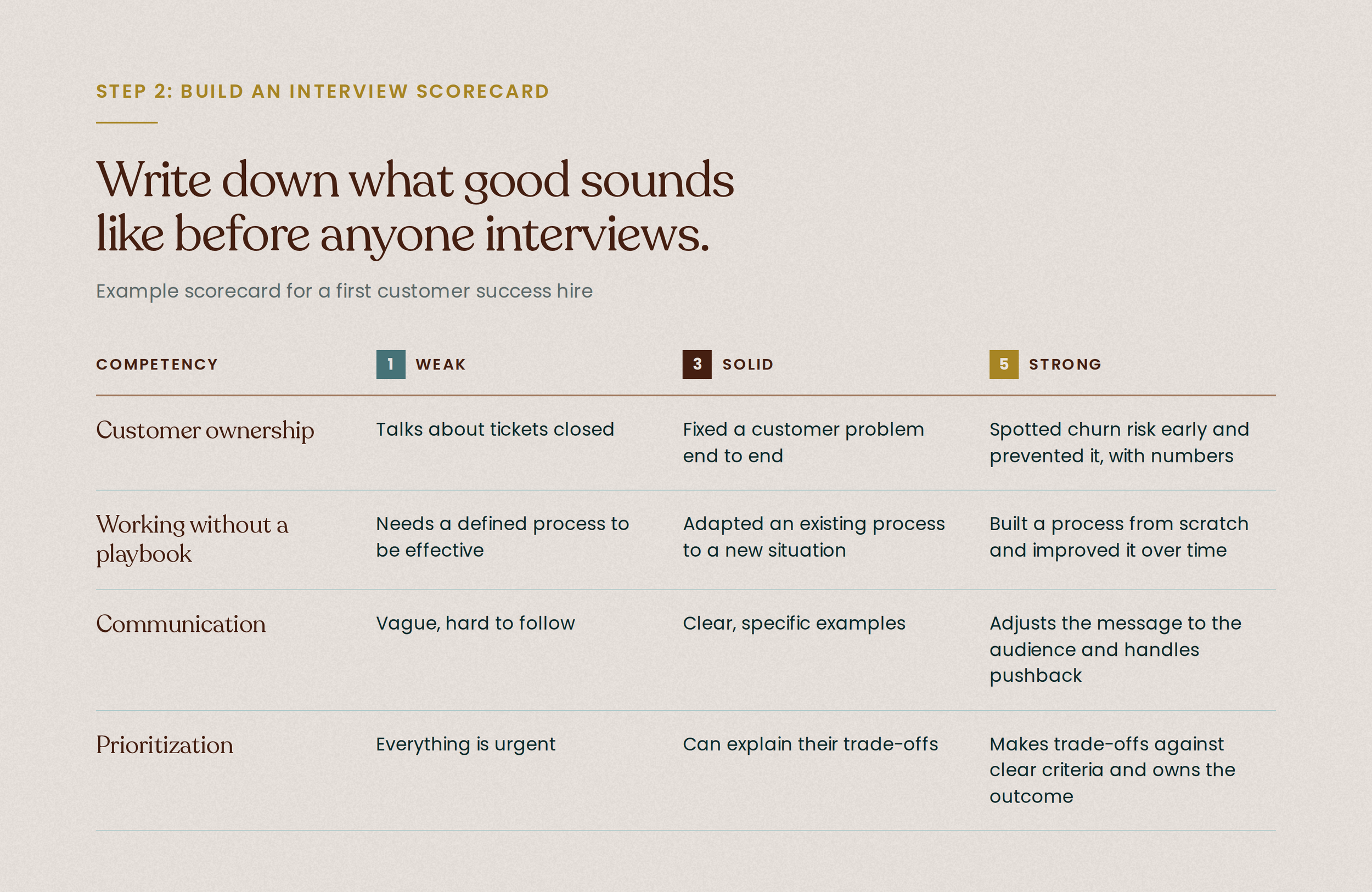
Every interviewer scores each competency on its own, right after the interview, before talking to anyone else. We'll come back to why that matters in the debrief.
Step 3: Design the entire interview process before you start
Every stage of your interview process should answer one question. If you can’t name the question a stage answers, cut it.
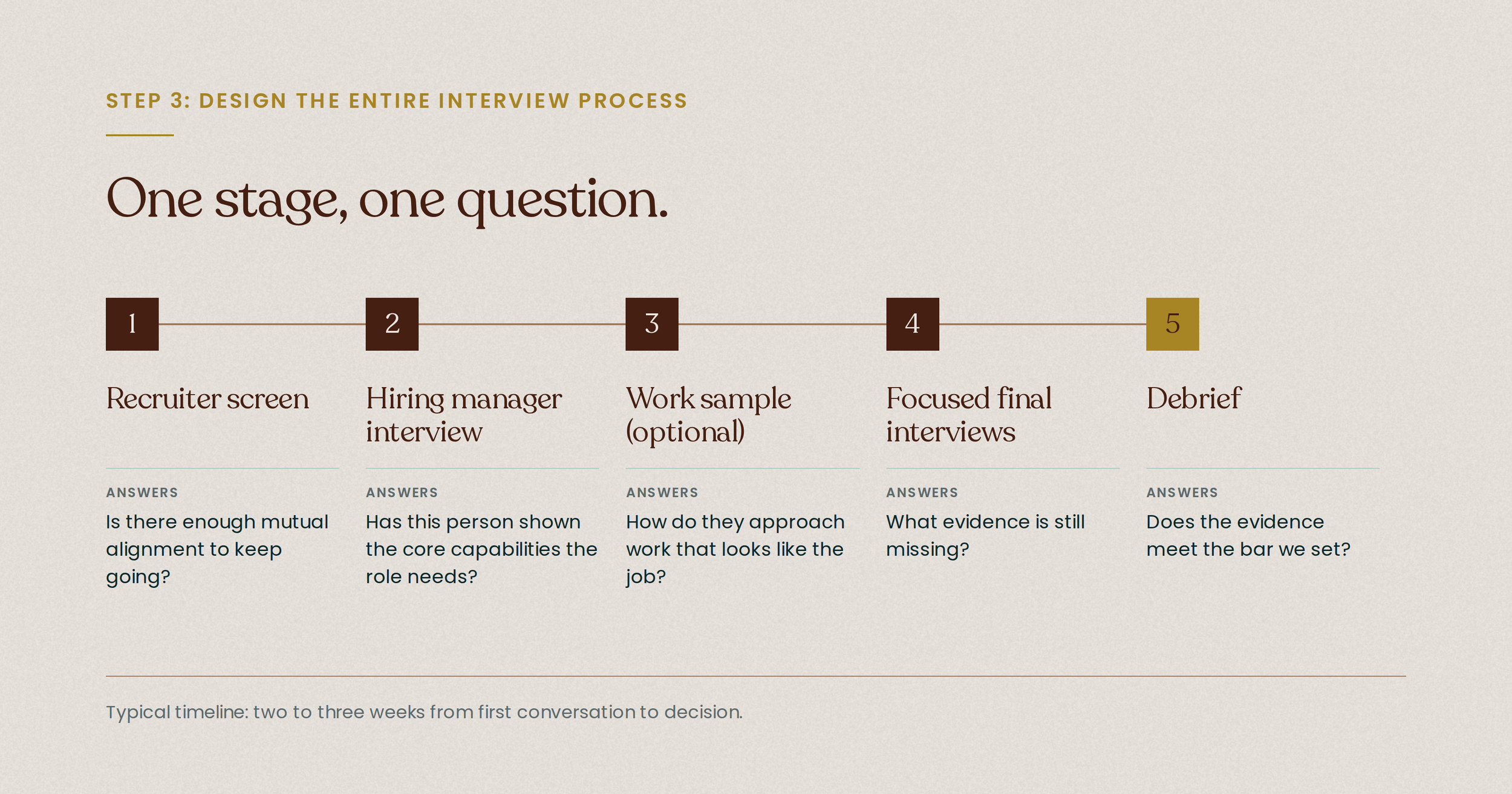
Agree before the first call how many rounds there are, who takes part in each one, which competencies each interviewer owns and what would make you stop, move someone forward or hire. That’s what keeps the process from growing every time someone says, “I’d just like one more conversation.”
Step 4: Set a clear, respectful timeline
For most roles, two to three weeks from first conversation to decision is realistic. Candidates should know from the start how many stages there are, who they’ll meet, whether there’s an assignment and when you expect to decide.
A sample timeline:
Recruiter screen or first conversation: 25 to 30 minutes
Hiring manager interview: 45 to 60 minutes
Work sample or case: no more than 60 to 90 minutes of preparation
Final interviews: consolidated into one day where possible
Debrief: within 24 hours of the last interview
Decision and communication: within one to two business days
If the timeline changes, tell candidates before they have to chase you for an update. Respect isn’t just being friendly in the interview. It’s running a process that recognizes the candidate may be working full time, juggling other responsibilities and talking to other companies.
Step 5: The recruiter screen: establish mutual alignment
The first conversation confirms the role makes sense for both sides. At most startups, that’s the founder or a talent partner rather than an in-house recruiter, and it shouldn’t try to be the whole interview.
Cover why they’re considering a move, what they want to own next, their relevant experience at a high level, compensation, location and availability, and anything that’s a clear non-negotiable. A few questions that work:
“What prompted you to consider a move?”
“What kind of scope are you hoping to own next?”
“Is there anything about this role that feels different from what you expected?”
This is also where you represent the role honestly. If the environment is ambiguous, fast-paced or very hands-on, say so. Candidates can’t judge fit from the polished version.
Step 6: The hiring manager interview: gather evidence of performance
The hiring manager interview is where you find out whether the person can do the job, measured against your scorecard. It shouldn’t repeat the first screen.
Two types of questions do most of the work in a structured interview.
Behavioural questions ask about something the candidate has actually done. “Tell me about a time you had to deliver a project with half the resources you expected.” They work best for experienced candidates, who have a track record to draw on.
Situational questions ask what they’d do in a realistic scenario from your world. “A customer threatens to churn the week before renewal and your manager is on vacation. What do you do first?” These work well for earlier-career candidates.
Write two or three questions for each competency on your scorecard, and ask the same ones of every candidate. The follow-ups are where the real evidence lives. Candidates default to “we.” Your job is to find out what they did:
What was your part, specifically?
What did you decide, and what did you rule out?
How did you know it worked?
What would you do differently now?
Right after the interview, the hiring manager should write down the evidence that supports the candidate, the evidence that’s missing, any concerns and the specific areas later interviewers should dig into. That shapes how deep the next rounds go without changing the criteria.
Step 7: Work samples and case studies without free consulting
Case studies are useful and easy to abuse. They show you how someone thinks. They can also turn into hours of unpaid consulting dressed up as an interview.
My rule is simple. If you could use the candidate’s work without hiring them, the exercise is too close to unpaid work.
A fair exercise is tied directly to the job, based on a fictional or already-solved problem, and takes no more than 60 to 90 minutes. Tell candidates exactly how long you expect them to spend and what you’ll be looking for. If you want more than that, pay them for their time.
Often the conversation afterward tells you more than the deliverable. Ask what assumptions they made, what information was missing and what they’d do next with more time.
Step 8: Final interviews: resolve, validate and go deeper
The final round builds on what you already know. Each interviewer should own a specific area: a gap the hiring manager flagged, cross-functional collaboration, leadership and influence, how they handle conflict and feedback, or the realities of working in your environment.
Later rounds should go deeper, not sideways. If your final interviewer is still asking “So, tell me about yourself,” the earlier stages didn’t do their job.
Step 9: Build candidate respect into the process
Your interview process is often a candidate’s clearest preview of how your company actually operates. A disorganized process tells them your leadership isn’t aligned. Silence after a final round tells them something worse.
The basics go a long way. Keep the number of interviews proportionate. Start and end on time. Don’t ask the same question in three different rounds. And close the loop with everyone who invested real time in your process.
(If you’re hiring in Ontario, closing the loop is now also the law for a lot of employers. Since January 1, 2026, employers with 25 or more employees must tell interviewed applicants whether a hiring decision has been made within 45 days of their last interview. I’m not a lawyer, so check how it applies to you, but the principle was always the right one.)
Step 10: The debrief: decide on evidence, not gut feel
The debrief is where good processes quietly fall apart. Someone senior says “I just didn’t feel it,” and the whole room folds. A few rules fix most of this.
Everyone submits their scorecard independently before the debrief. No hallway chats, no Slack threads comparing notes first.
Every opinion connects to a competency and an example. “I didn’t feel a connection” isn’t feedback. “They couldn’t give me one example of working without a playbook, which is most of this job” is.
And the debrief ends in one of three places: hire, don’t hire, or go get one clearly defined missing piece of evidence. Not an open-ended extra round because nobody wants to make the call.
I’m not afraid to call it in a debrief, even when a candidate looks great on paper. But the call has to come from the evidence, and the scorecard is what makes that conversation possible.
Frequently asked questions
-
A structured interview asks every candidate the same questions, in the same order, and scores their answers against criteria agreed before interviews begin. It's designed to compare candidates on evidence of job-relevant skills rather than on overall impressions or how well the conversation flowed.
-
Structure doesn’t mean reading from a script. It means being consistent where consistency matters and human everywhere else.
Open with a two-minute overview of how the interview will run. It settles nerves and keeps you honest.
Keep the small talk short. Remember what it does to your scoring.
Ask your core questions in the same order for every candidate.
Probe with follow-ups until you have a specific example, not a general philosophy.
Take notes on what they said, not how you felt. “Rebuilt onboarding and cut ramp time by half” is evidence. “Seemed sharp” is not.
Leave ten minutes for their questions. They are interviewing you too.
Fill in your scorecard within the hour, before you compare notes with anyone.
-
In an unstructured interview, each interviewer asks whatever feels relevant and forms an overall impression. In a structured interview, the questions, their order and the scoring are set in advance. Research consistently finds structured interviews predict job performance far better, roughly twice as well in Sackett's 2022 analysis.
-
For most roles, three or four stages is enough: a first screen, a hiring manager interview, an optional work sample and focused final interviews. Each stage should answer one specific question. Aim for two to three weeks from first conversation to decision.
-
Yes, and they arguably matter more. On a small team, one bad hire has an outsized impact and there's no HR function to catch it. A simple scorecard with four or five competencies and a shared question list takes a few hours to build and can be reused every time you hire for that role.
Conclusion
Skipping the structured work to save a week almost always costs founders months.
A structured interview process isn't bureaucracy. It's how a small team hires like it has a talent function before it can afford one.
If you're building your first real hiring process and want a second set of eyes, or you'd rather hand the whole thing to a partner who works right inside your Slack, that's what we do at InTandem Talent. Either way, I'd love to hear what's worked for you. What's the one part of your interview process you'd fix first?