How We Rebuilt Our Recruiting Stack Around AI with Noon (Our LinkedIn Recruiter Alternative)
A few years ago, our recruiting looked like everyone else's. Boolean strings in LinkedIn Recruiter, InMails, a lot of copy and paste, and long afternoons building lists by hand.
That's not how we work anymore. Over the past year we've moved from a traditional recruiting model to an AI-accelerated one, and our tools had to come with us. Part of that was finding a LinkedIn Recruiter alternative that fit a small team.
This is the behind-the-scenes look at what we used, where it broke, what we moved to, and what changed in our AI-supported recruitment approach.
Why we stopped using LinkedIn Recruiter
We started where most recruiters start, on LinkedIn Recruiter. It's still the biggest professional network, and it does what it says. But for us, sourcing meant manual Boolean search and outreach meant InMails, and candidates have learned to ignore InMails.
The cost was another sticking point. LinkedIn doesn't publish Recruiter pricing, but buyers report roughly $10,800 to $12,960 per seat per year for the full product, on an annual contract. Every person who searches needs their own seat. LinkedIn's own comparison lists no AI features on Recruiter Lite, and its AI Hiring Assistant is an add-on for the full product (LinkedIn Help).
So we moved to Juicebox, an AI sourcing tool. It's a good product, and its natural-language search was a real step up. But it's priced per seat, per month, in US dollars, with AI agents as a paid add-on on top. We paid about $200 a seat on its Growth plan, plus agents.
Here's where both broke for us. Our core team is four people, and it flexes. Some months we add help for a new client. Some months we don't. Per-seat pricing punishes the flexibility we have built our business around.
Why we moved to Noon
We switched most of our sourcing to Noon (noon.ai). It came down to how we actually run the business.
The cost is predictable. We pay one flat annual fee. No seat fees, no credits, no surprise add-ons.
Our team can flex without a bill. Recently we brought on a contractor for four months to support a new client. On Juicebox, that's another seat for every month they're with us. On LinkedIn Recruiter, it's a new licence on an annual contract for someone staying four months. On Noon, it cost us nothing extra.
The AI is included. Sourcing and outreach agents come with the plan. Nobody upsells us on the part that does the work. (With other tools, this is sometimes an add-on)
It keeps up with our clients. We work with fast-moving startups and AI-native companies. They expect us to move at their pace, and our tools set the ceiling on how fast we can go.
The team behind it moves with us. Noon's team is very responsive. When we've asked for features, they've landed the following week. Most software companies don't build around a four-person shop.
How the costs compare
Here's what made the decision easy. Annual list prices are estimated in USD, before add-ons and taxes.
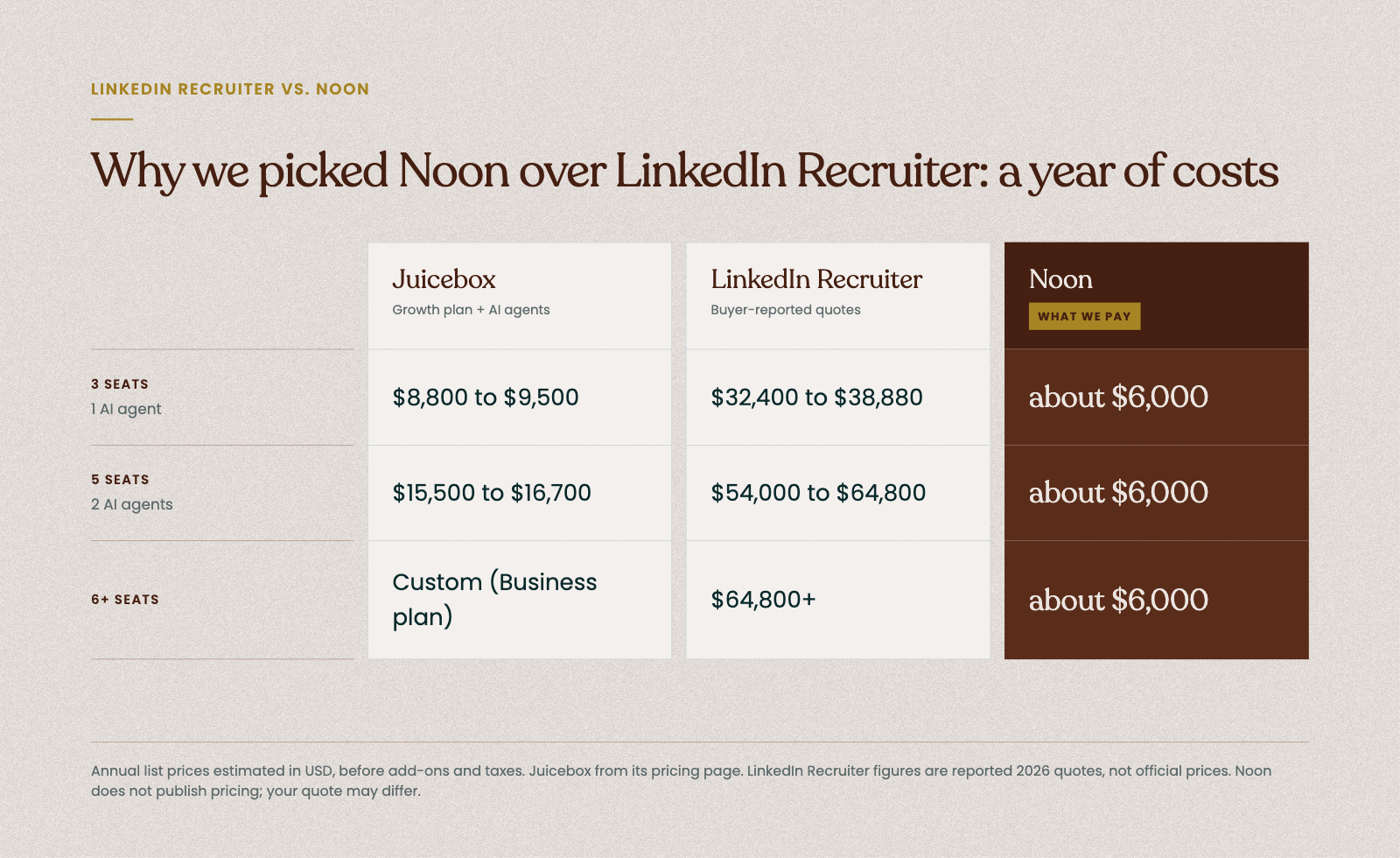
Juicebox figures come from its pricing page: Growth at $179 per seat per month billed annually or $199 monthly, plus $199 per agent per month, with a custom Business plan past five seats. LinkedIn figures are reported 2026 quotes, not official prices. Noon doesn't publish pricing (Noon pricing), so your quote may differ from ours.
How we work with it now
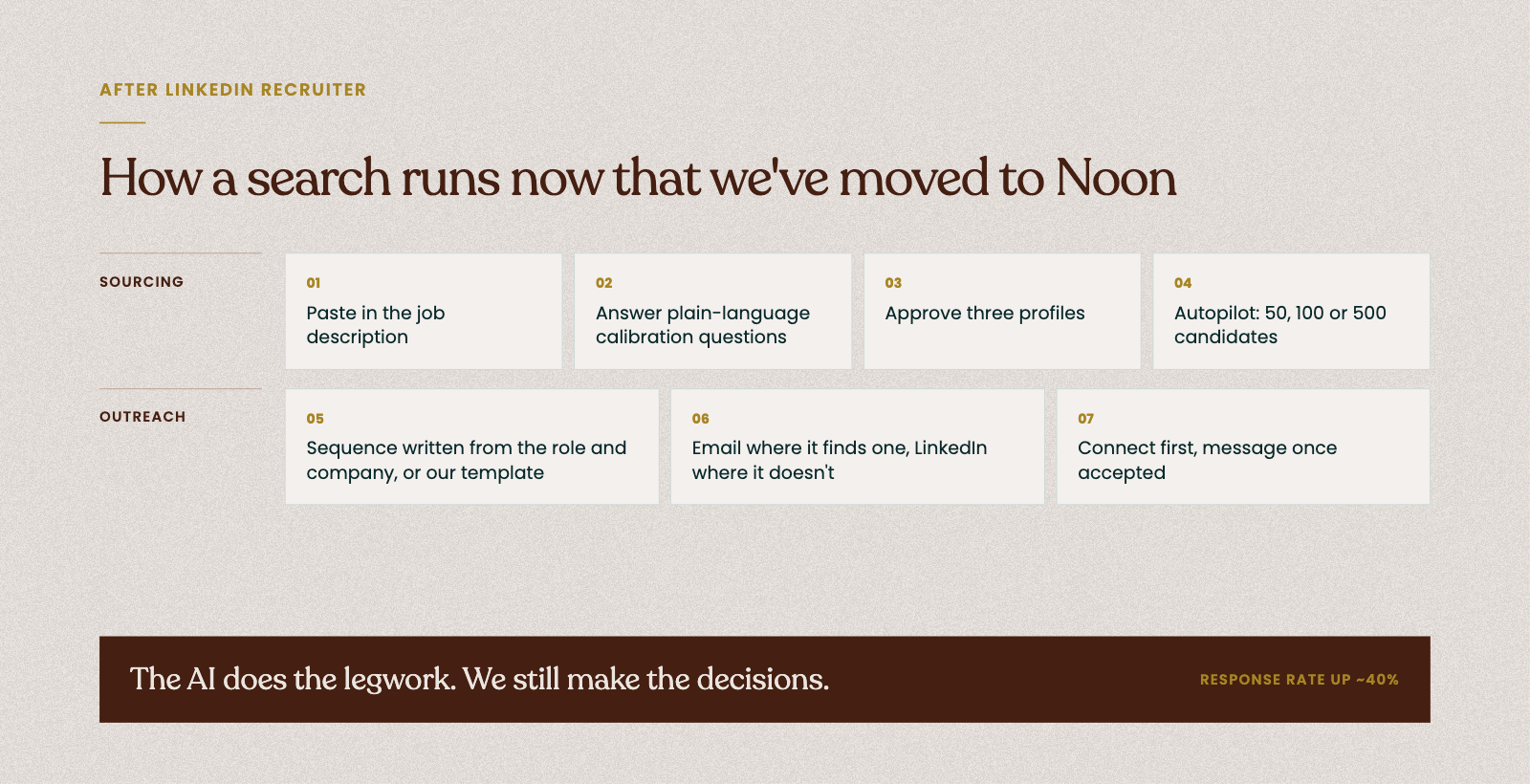
Sourcing starts with the job description. We paste it in, and Noon asks calibration questions in plain language, like "You said five years. Is under five okay?" It serves up profiles, and once we approve three, it switches to autopilot. We set the volume (50, 100 or 500 candidates) and go do other work. If the list skews wrong, we say so ("too junior") and it scrubs the list.
Outreach runs from the same place. Noon writes a sequence from the job description and company information, or we use our own template. It finds emails where it can and falls back to LinkedIn where it can't, sending a connection request first and the message once it's accepted. Phone and text sequences are there too, and we're trying them on a current search.
The AI does the legwork. We still make the decisions.
What changed
Compared with tools like LinkedIn Recruiter, our response rate is up about 40%.
We think we know why. InMails are easy to ignore because candidates know exactly what they are. Cold emails on their own often land in spam. Connecting first and messaging second feels more like a real introduction, costs nothing in InMail credits, and builds a little trust before we ask for anyone's time.
What we still use, and what to know
We didn't cut LinkedIn out entirely. We keep LinkedIn Recruiter Lite for the searches that call for it. It just isn't where most of our sourcing happens anymore.
And a few honest caveats if you're considering Noon.
There's no public price, so you'll need a demo and a quote.
A flat annual fee is predictable, but it's still a year. Run a real search before you sign.
It doesn't replace judgment. Someone still has to answer replies, run interviews and close.
We also didn't test every tool out there. This is the move we made, not a ranking.
Tools changed. The job didn't.
AI gave a four-person team the sourcing reach that used to take a much bigger one. That part is real. But finding names was never the hard part of hiring. Defining the role, deciding who's actually good, keeping candidates in the loop and closing the offer is where the real value comes from. We wrote more about that balance in AI Hiring: What's Working, What's Broken, and Where Humans Still Matter.
If you're a founder hiring on your own, a tool can get you candidates. A partner gets you hires. That's the work we do as a fractional recruiting partner: embedded in your team, bringing the tools and the judgment, on a flat monthly retainer priced on the number of roles you're hiring for, not a percentage of salary.
If you're weighing a tool against a partner, we're happy to talk it through. See how fractional recruiting works or reach out.